Benchmarks
Parakeet is benchmarked head-to-head against general array compilers
(torch.compile, JAX jit, CuPy, NumPy) and specialist libraries
(Faiss, PyKeOps, scikit-learn, SciPy, PyTorch SDPA / cross_entropy).
Every figure plots all individual warmed replicates, the interquartile
range (IQR, 25th–75th percentile), and the median directly from the
committed raw JSON logs — and every workload links to its runnable source code.
At a glance (NVIDIA L4 & 4-thread CPU)
Latest measurements come from one Google Colab VM with an NVIDIA L4 GPU and
a 4-thread CPU at compiler revision 0dcb7d5 (float32, GPU inputs
resident on device, explicit synchronization, reference-checked outputs,
n = 21 GPU replicates / n = 11 CPU replicates).
Download full raw JSON (samples, compile times, allocations, training logs).
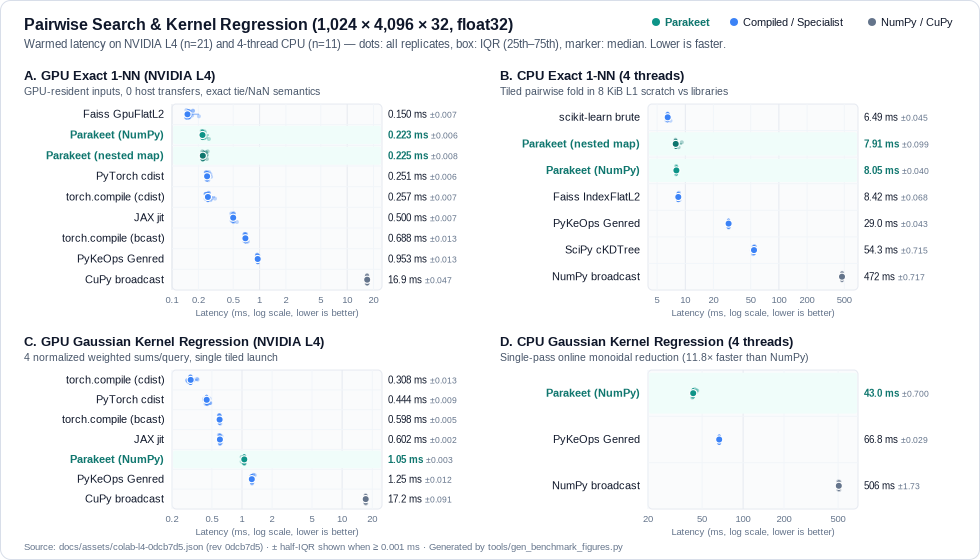
Key takeaways:
- Exact 1-NN (
1,024 × 4,096 × 32): On the L4 GPU, Parakeet's ordinary broadcasting NumPy (0.223 ms) and nested-map form (0.225 ms) both beattorch.compile(cdist)(0.257 ms),PyTorch cdist(0.251 ms),JAX jit(0.500 ms),PyKeOps(0.953 ms), andCuPy(16.93 ms), trailing onlyFaiss GpuIndexFlatL2(0.150 ms). On 4 CPU threads, Parakeet (7.91 ms) beatsFaiss Flat(8.42 ms),PyKeOps(29.03 ms),SciPy cKDTree(54.27 ms), andNumPy(472.3 ms), just behindscikit-learnbrute (6.49 ms). - Scaling to 16,384 references: Tiled GPU pairwise folds cut latency by
4.8× (
2.597 ms → 0.542 mson L4) and cut global scratch memory by 21× (64 MiB → 3 MiB, plus a16 KiBshared-memory tile per block). - Gaussian kernel regression: On 4 CPU threads, Parakeet (42.99 ms)
beats
PyKeOps(66.77 ms) andNumPy(505.8 ms, 11.8× faster). On GPU, Parakeet (1.053 ms) beatsPyKeOps(1.254 ms) andCuPy(17.18 ms), whiletorch.compile(cdist)(0.308 ms) andJAX jit(0.602 ms) lead. - End-to-end nanoGPT training (
16 × 64 × 128 × 2): Parakeet with TF32 WMMA (6.83 ms/step) and FP32 (8.44 ms/step) both beat eager PyTorch (9.22 ms/step) with identical loss curves, whiletorch.compile(3.52 ms) andJAX jit(1.62 ms) lead on larger dense transformer blocks.
Pairwise search and kernel regression
NVIDIA L4 GPU and 4-thread CPU (1,024 × 4,096 × 32, float32)
Warmed medians in milliseconds (lower is faster). Faiss and scikit-learn times
exclude index construction. Implementations:
nearest_numpy,
exact_1nn,
rbf_kernel_regression.
| Implementation | CPU 1-NN (ms) | GPU 1-NN (ms) | CPU Gaussian (ms) | GPU Gaussian (ms) |
|---|---|---|---|---|
| Parakeet (broadcasting NumPy) | 8.050 | 0.223 | 42.990 | 1.053 |
Parakeet (nested par.map) |
7.907 | 0.225 | — | — |
Faiss Flat (IndexFlatL2 / GpuIndexFlatL2) |
8.417 | 0.150 | — | — |
| scikit-learn brute | 6.492 | — | — | — |
torch.compile over cdist |
— | 0.257 | — | 0.308 |
PyTorch cdist |
— | 0.251 | — | 0.444 |
torch.compile over broadcasting |
— | 0.688 | — | 0.598 |
JAX jit |
— | 0.500 | — | 0.602 |
PyKeOps Genred |
29.027 | 0.953 | 66.769 | 1.254 |
SciPy cKDTree (exact) |
54.266 | — | — | — |
| NumPy / CuPy broadcasting | 472.283 | 16.932 | 505.780 | 17.177 |
At the smaller 256 × 1,024 × 3 shape, CPU PyKeOps led at 0.219 ms
(interleaved sweep: 0.241 ms) vs. 0.559 ms for Parakeet broadcasting, and
GPU JAX jit led at 0.079 ms vs. 0.179 ms for Parakeet broadcasting. Note
that on the large Gaussian workload, JAX's first-call compilation took 672 s
before reaching its 0.602 ms warmed median (all tables report warmed
execution times).
Scaling exact 1-NN with reference count
Eliminating the materialized Q × R distance matrix changes both memory
scaling and GPU throughput. On both NVIDIA L4 (0dcb7d5 vs. 1.0.0 baseline
7ddd90a) and NVIDIA A10G (raw A10G JSON),
both the broadcasting NumPy form and the explicit operator form compile to the
same tiled pairwise fold with zero host transfers and exact first-index
tie/NaN semantics.
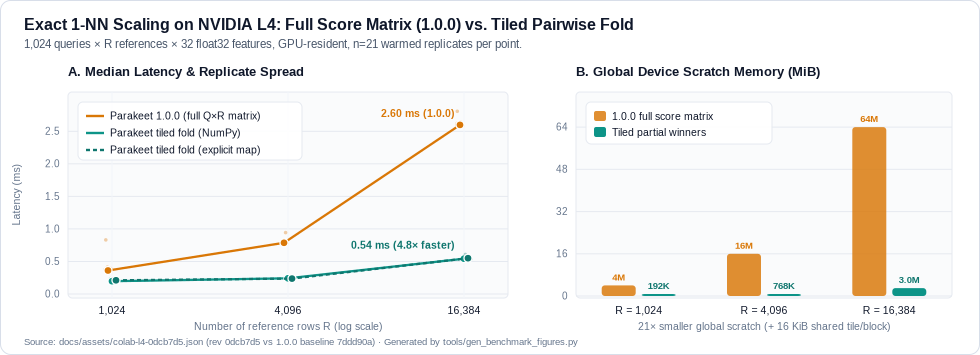
References (Q = 1,024, D = 32) |
L4 1.0.0 NumPy |
L4 Tiled NumPy | L4 Tiled par.map |
A10G 1.0.0 NumPy |
A10G Tiled NumPy | A10G Tiled par.map |
1.0.0 Global Scratch |
Tiled Global Scratch |
|---|---|---|---|---|---|---|---|---|
| 1,024 | 0.361 ms | 0.197 ms | 0.210 ms | 0.296 ms | 0.135 ms | 0.139 ms | 4 MiB | 192 KiB |
| 4,096 | 0.787 ms | 0.241 ms | 0.236 ms | 0.853 ms | 0.190 ms | 0.180 ms | 16 MiB | 768 KiB |
| 16,384 | 2.597 ms | 0.542 ms | 0.550 ms | 2.898 ms | 0.458 ms | 0.470 ms | 64 MiB | 3.0 MiB |
Each active tiled threadblock also uses a 16 KiB shared-memory score tile.
The 1.0.0 nested-map form was not GPU-eligible (it required CPU fallback);
the tiled pairwise fold executes both spellings strictly on CUDA with zero
fallbacks.
Structured state (par.fold vs. NumPy)
At 1,024 × 4,096 × 32 on the L4 with strict CUDA dispatch and zero timed host
transfers (browse both programs):
- Exact 1-NN: explicit
par.fold(nearest_fold) took 0.235 ms vs. broadcasting NumPy (nearest_numpy) at 0.222 ms. - Inverse-distance smoothing: explicit
par.fold(smooth_fold) took 0.270 ms (2 kernel launches) vs. broadcasting NumPy (smooth_numpy) at 0.275 ms (3 kernel launches).
Forward GPU kernels and nanoGPT training
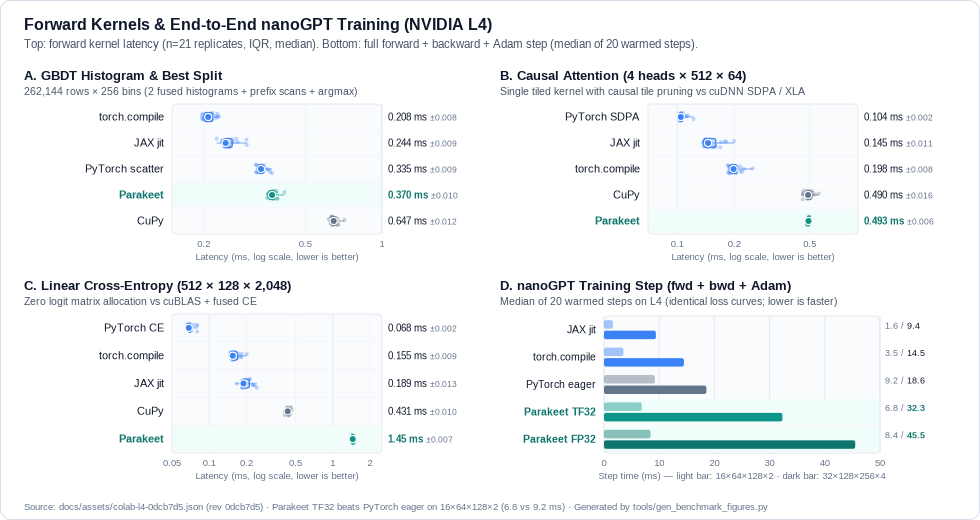
Forward GPU workloads (NVIDIA L4, n = 21 warmed calls)
| Workload | Parakeet | PyTorch | torch.compile |
JAX jit |
CuPy | Implementation |
|---|---|---|---|---|---|---|
GBDT split (262,144 × 256 bins) |
0.370 ms | 0.335 ms | 0.208 ms | 0.244 ms | 0.647 ms | gbdt_best_split |
Causal attention (4 × 512 × 64) |
0.493 ms | 0.104 ms (SDPA) | 0.198 ms | 0.145 ms | 0.490 ms | causal_flash_attention |
Linear cross-entropy (512 × 128 × 2,048) |
1.447 ms | 0.068 ms | 0.155 ms | 0.189 ms | 0.431 ms | cut_cross_entropy |
End-to-end nanoGPT training (NVIDIA L4)
Each step runs the full forward pass, reverse-mode backpropagation, and Adam
update (4 attention heads, median of 20 warmed steps in milliseconds). Parakeet
and JAX compile the optimizer directly into the training step; torch.compile
wraps the forward/loss and runs the optimizer separately. Initial and final
losses match across all arms (4.200 → 1.426 on the smaller configuration).
Follow the complete nanoGPT walkthrough.
| Batch × context × width × layers | Parakeet FP32 | Parakeet TF32 (WMMA) | PyTorch eager | torch.compile |
JAX jit |
|---|---|---|---|---|---|
16 × 64 × 128 × 2 |
8.439 ms | 6.833 ms | 9.217 ms | 3.515 ms | 1.619 ms |
32 × 128 × 256 × 4 |
45.499 ms | 32.317 ms | 18.554 ms | 14.480 ms | 9.411 ms |
Benchmark implementations and reproduction
Every table and figure on this page is backed by runnable repository code and raw JSON samples:
| Suite / Workload | Runnable code | Repro command |
|---|---|---|
| Release cross-framework suite (CPU & GPU) | benchmarks/release_comparison.py |
python benchmarks/release_comparison.py / modal run tools/modal_release_bench.py |
| GPU exact 1-NN pairwise fold scaling | benchmarks/gpu_pairwise_fold.py |
python benchmarks/gpu_pairwise_fold.py / modal run tools/modal_pairwise_fold.py |
| Gallery kernels (1-NN, smoothing, RBF, attention, CCE, MLA, GQA, Mamba-2, tropical, GBDT) | examples/algebraic_gallery.py |
python -m examples.algebraic_gallery |
| Character-level nanoGPT training | examples/nanogpt.py |
python examples/nanogpt.py |
| Bioinformatics workloads | benchmarks/bio_workloads.py |
python benchmarks/bio_workloads.py |
| Local CPU micro-benchmarks (NumPy vs. 1/N threads) | benchmarks/run.py |
python benchmarks/run.py |
| Regenerate all SVG figures on this page | tools/gen_benchmark_figures.py |
python tools/gen_benchmark_figures.py |
Historical 1.0.0 baseline (Modal NVIDIA A10 & 4-vCPU)
For continuity with the original 1.0.0 release (compiler revision
0345559f, NVIDIA A10 24 GiB, driver 620.70.06, 4-vCPU worker), the initial
pre-pairwise-fold release measurements are archived below.
Download raw 1.0.0 Modal JSON.
1.0.0 Four-vCPU worker (warmed median, ms)
| Implementation | Small 1-NN (256×1024×3) |
Large 1-NN (1024×4096×32) |
Small Gaussian | Large Gaussian |
|---|---|---|---|---|
| Parakeet, broadcasting NumPy | 0.664 | 6.593 | 2.971 | 28.951 |
Parakeet, nested par.map |
0.638 | 6.132 | — | — |
PyKeOps Genred |
0.255 | 18.246 | 1.087 | 38.038 |
Faiss IndexFlatL2 |
0.033 | 9.577 | — | — |
SciPy cKDTree (exact) |
1.441 | 51.846 | — | — |
| scikit-learn brute | 1.042 | 6.647 | — | — |
| NumPy broadcasting | 9.899 | 326.690 | 10.915 | 359.939 |
1.0.0 NVIDIA A10 (warmed median, ms — prior to GPU pairwise-fold tiling)
| Implementation | Small 1-NN | Large 1-NN | Small Gaussian | Large Gaussian | Causal Attn | Linear CE | GBDT Split |
|---|---|---|---|---|---|---|---|
Parakeet 1.0.0 |
0.261 | 0.796 | 0.226 | 1.130 | 0.386 | 1.604 | 0.276 |
| PyTorch eager / specialist | 0.128 | 0.323 | 0.166 | 0.568 | 0.090 | 0.069 | 0.225 |
torch.compile |
0.089 | 0.208 | 0.106 | 0.294 | 0.116 | 0.088 | 0.175 |
JAX jit |
0.115 | 0.424 | 0.098 | 0.663 | 0.217 | 0.133 | 0.188 |
PyKeOps Genred |
0.262 | 0.962 | 0.295 | 1.289 | — | — | — |
Faiss GpuIndexFlatL2 |
0.079 | 0.154 | — | — | — | — | — |
| CuPy | 0.483 | 12.359 | 0.527 | 12.736 | 0.326 | 0.255 | 0.420 |
Methodology notes
- Every benchmark arm is checked against a reference implementation (exact index equality for 1-NN and split finding; tight floating-point tolerance for reductions, attention, and training losses).
- GPU arms time GPU-resident inputs with explicit CUDA synchronization before and after each replicate; first-call compilation times are recorded separately in the JSON downloads and excluded from warmed medians.
- On CPU, Parakeet's pairwise fold allocates an
8 KiB(16 × 128float32) score tile plus192 Bof row summaries per active strip; on GPU, it uses a16 KiBshared-memory score tile per block andO(Q · #tiles)global partial winners rather than anO(Q · R)distance matrix.